Caterpillar Acquires Assets of Collapsed Electric Autonomous Tractor Startup Monarch Tractor
Construction industry giant Caterpillar has purchased all assets of electric autonomous tractor startup Monarch Tractor, following the company’s failed attempt to pivot its core business to software-focused services, according to official filings with the United States Patent and Trademark Office.
The acquisition, first reported exclusively by Bloomberg, brings a close to several years of mounting turmoil for Monarch, which weathered multiple rounds of layoffs, three separate lawsuits from authorized dealers, and the exit of its primary contract manufacturing partner, Foxconn. The deal also comes just weeks after co-founder and winemaking scion Carlo Mondavi revealed he was forced out of the company after clashing with CEO Praveen Penmetsa over Penmetsa’s software-first strategic approach.
Mondavi could not be immediately reached for comment on the acquisition. Penmetsa declined to share additional remarks beyond a statement Monarch released last week, which only confirmed that the startup’s technology had been acquired by an unnamed “large global equipment manufacturer.” Caterpillar also did not immediately respond to requests for comment.
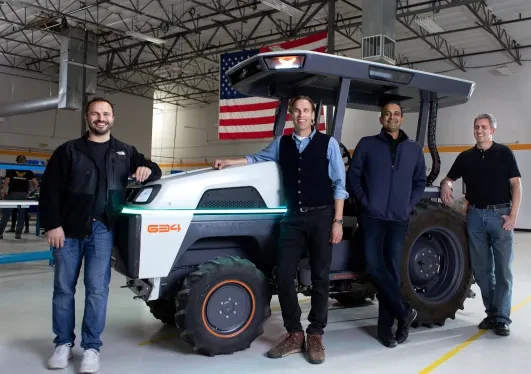
Founded in 2018 by Mondavi, Penmetsa, and former Tesla executive Mark Schwager, Monarch raised more than $200 million in total capital over its eight years of operation. The startup launched with a clear mission: build “driver-optional” electric tractors equipped with autonomous navigation, purpose-built for use across vineyards, fruit orchards, and dairy operations.
While Monarch originally planned to manufacture its compact tractors at its own facility in Livermore, California, the company ultimately joined three other electric vehicle startups in a partnership with Taiwanese manufacturing giant Foxconn to produce vehicles at the shuttered former General Motors factory in Lordstown, Ohio.
Foxconn agreed to build vehicles for three EV startups — Fisker, Lordstown Motors, and IndiEV — alongside Monarch’s tractors at the Lordstown site. But the entire manufacturing venture collapsed amid a wave of industry bankruptcies: Foxconn only produced a small batch of electric pickups for Lordstown Motors (which originally sold the factory to Foxconn) before Lordstown entered bankruptcy. Both Fisker and IndiEV also filed for bankruptcy before Foxconn could launch mass production of their vehicles. Though Foxconn did assemble a few hundred Monarch tractors at the plant, the manufacturing conglomerate sold the entire facility to SoftBank in August 2025, leaving Monarch without any production partner.
By the time the Lordstown plant changed hands, Monarch was already facing severe financial strain. The startup cut staff in early 2024, shortly before closing a $133 million funding round. Just months later, it implemented even deeper layoffs and announced a full restructuring to shift focus to software development and licensing its autonomous farm technology.
Meet your next investor or high-potential portfolio startup at Disrupt
Your next funding round. Your next key hire. Your next game-changing opportunity. Find it all at TechCrunch Disrupt 2026, where 10,000+ founders, investors, and tech leaders gather for three days of 250+ tactical sessions, valuable introductions, and market-defining innovation. Register now to save up to $410.
Meet your next investor or high-potential portfolio startup at Disrupt
Your next funding round. Your next key hire. Your next game-changing opportunity. Find it all at TechCrunch Disrupt 2026, where 10,000+ founders, investors, and tech leaders gather for three days of 250+ tactical sessions, valuable introductions, and market-defining innovation. Register now to save up to $410.
Dealers that have sold Monarch tractors have long claimed the startup’s autonomous technology never worked as advertised. One dealer that sued Monarch in September 2025 called the company’s tractors “defective” and “unable to operate autonomously.” Monarch denied all claims in its official court filing. Two other dealers have since filed similar federal lawsuits against the startup. In one January court filing, a former defense attorney for Monarch noted that the company entered an assignment for the benefit of creditors — a debt settlement process that serves as an alternative to Chapter 7 bankruptcy.
Mondavi spoke publicly about his departure last month in a comment on an Instagram post from a farmer who shared complaints about Monarch’s tractors. The winemaker wrote he “left over a year ago due to fundamental differences in approach” after seeing “reliability issues” with Monarch tractors on his own farm and the farms of his colleagues.
“I wanted to address them through hardware changes, while the CEO believed they could be solved more through software. I believed strongly in a different path but was ultimately blocked and pushed out alongside another co-founder,” he wrote.
Earlier this year, Monarch auctioned off nearly all of its remaining unsold tractors to liquidate its remaining assets.
Find Your Next Breakthrough at TechCrunch Disrupt 2026