This week at San Francisco’s HumanX AI conference, thousands of technology professionals flocked to the city’s Moscone Center, where the top conversation centered on how agentic AI is transforming the global business landscape. AI agents — tools that automate core business and coding workflows — are already rolling out across nearly every sector, most commonly integrated into enterprise and consumer-facing chatbots.
Curious which chatbot was leading the pack among attendees, I asked around again and again — and one name kept coming up more than any other: Claude.
Anthropic, the company behind Claude, earned frequent shoutouts across the conference’s panel discussions, and it was also a top talking point among the vendors I chatted with while walking the exhibition floor. What name barely came up in conversation? OpenAI’s ChatGPT. One vendor I spoke with even went out of his way to tell me that he and his entire team rely heavily on Claude, and in his view, ChatGPT and OpenAI as a whole have gone downhill — or to use the popular internet phrase, they’ve “fell off.”
Lately, this opinion is far from unique. Even though OpenAI just closed a massive $122 billion funding round and is gearing up for its highly anticipated initial public offering, there’s a persistent narrative that the company has lost its momentum — or at the very least, is growing increasingly uncertain about its next strategic move.
A big part of this negative perception stems from a widespread sense that the company lacks clear strategic focus. Last month, OpenAI scrapped multiple long-gestating side projects, including its AI video generator Sora and a troubled effort to launch a flirtatious “sexy” variant of ChatGPT, to refocus its full resources on business and coding services. At the same time, a string of recent developments have fueled negative chatter around the company: most notably a high-profile New Yorker profile that raised questions about CEO Sam Altman’s credibility. The company’s previous work with the Trump administration has also failed to win it support from many industry insiders, and its decision to roll out advertising on ChatGPT has similarly drawn criticism.
During a HumanX conference discussion, Bret Taylor — co-founder and CEO of Sierra, who also serves as OpenAI’s board chairman — defended Altman when moderator Alex Heath brought up the controversial New Yorker profile. “Sam is one of the most visible leaders and executives in the world,” Taylor said. “If you go looking for detractors of Sam, you will find them, and they will be very vocal about their opinions.” He added, “I think Sam is remarkable. He’s an extraordinary leader for the AI space, and having worked alongside him, I really trust his character.”
These ongoing controversies and frequent shifts in priority have left many seeing OpenAI’s moves as reactive rather than strategic, as if the company is just responding to events instead of shaping the future of the industry. That said, when it comes to brand visibility and revenue, OpenAI and Anthropic are still neck and neck — or at least that’s how the race stands today, with some data indicating Anthropic is quickly catching up among business users. A recent Wall Street Journal analysis of the two companies’ financials found that both rank among the fastest-growing businesses in modern tech history. In that light, OpenAI “falling off” may just mean it’s no longer the unchallenged top dog in the space. It finally has real competition — which is a normal part of any mature industry.
Connect with your next investor or portfolio startup at TechCrunch Disrupt
Your next funding round. Your next key hire. Your next game-changing opportunity. Find it all at TechCrunch Disrupt 2026, where 10,000+ founders, investors, and tech leaders gather for three days of 250+ tactical sessions, high-impact introductions, and market-defining innovation. Register now to save up to $410 on your pass.
Connect with your next investor or portfolio startup at TechCrunch Disrupt
Your next funding round. Your next key hire. Your next game-changing opportunity. Find it all at TechCrunch Disrupt 2026, where 10,000+ founders, investors, and tech leaders gather for three days of 250+ tactical sessions, high-impact introductions, and market-defining innovation. Register now to save up to $410 on your pass.
One thing is clear: OpenAI remains fully committed to doing whatever it takes to hold onto its dominant market position. Just this week, the company announced a new $100 monthly subscription tier for ChatGPT that includes significantly expanded access to Codex, its in-house coding tool. The move is widely viewed as an intentional push to drive broader adoption of OpenAI’s coding offerings, while also poaching users away from Anthropic’s popular Claude Code tool.
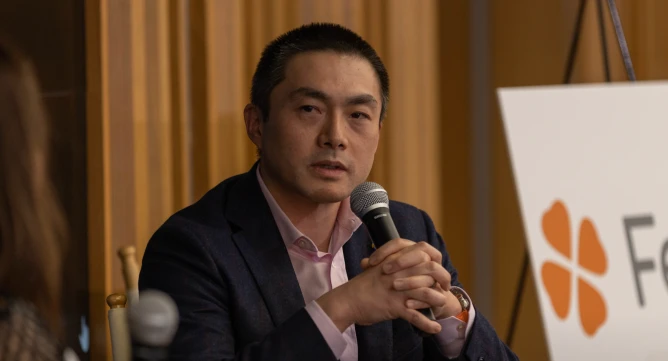
During a HumanX conversation with Bloomberg reporter Rachel Metz, Srinivas Narayanan, OpenAI’s CTO for B2B applications, noted just how rapidly the AI technology landscape is shifting. “We’re in an incredible moment for technology, where every month — and sometimes even every day — we’re all looking ahead to the next new development,” Narayanan said. Using agentic AI coding as an example, he added, “We always knew AI would transform software engineering, and people have used AI-assisted coding for the last year, but even just over the past few months, the entire field has changed completely.”
Today, agentic AI advancements are the top focus for much of the tech community, largely because many other popular AI use cases — such as AI-powered creative tools — have yet to live up to early hype. Even so, the volume of work that companies have already begun offloading to these new automated AI helpers is somewhat surprising, and as Narayanan noted in his comments, this entire shift has unfolded in a remarkably short period of time. In such an unpredictable, fast-evolving environment, the future of the global AI race remains wide open.
Connect with your next investor or portfolio startup at TechCrunch Disrupt