The Emerging Near-Term Business of In-Orbit Computing, Led by Kepler and Sophia Space
Despite all the hype surrounding space-based data centers, there are surprisingly few graphics processing units (GPUs) currently operating in orbit. But as that gap begins to close, a tangible, near-term business model for orbital computing is finally starting to take shape.
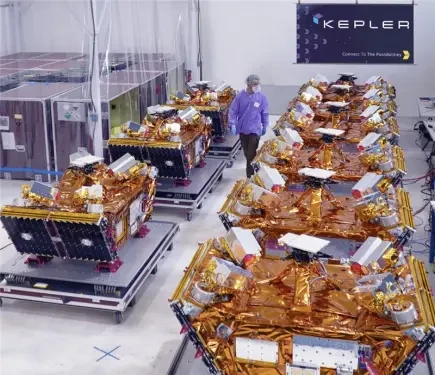
Right now, the largest active compute cluster circling Earth was launched in January by Canadian satellite firm Kepler Communications. The network spans 10 operational satellites, carries roughly 40 Nvidia Orin edge processors, and connects all hardware via high-speed inter-satellite laser links.
Kepler now counts 18 customers across its constellation, and announced its newest partnership Monday with Sophia Space, a startup that will trial software for its proprietary in-orbit computing system on Kepler’s network.
Industry experts broadly agree that the large-scale orbital data centers envisioned by SpaceX and Blue Origin won’t launch until the 2030s. For the coming decade, the first major commercial use case for in-orbit computing will be processing data directly gathered in space, to boost the performance of space-based sensors used by private companies and government agencies alike.
Kepler does not position itself as a space data center operator, but rather as foundational infrastructure for all types of space-based applications, CEO Mina Mitry told TechCrunch. The firm aims to operate as a shared neutral layer, delivering networking services to other satellites in orbit, as well as drones and aircraft flying in Earth’s atmosphere below its constellation.
Sophia, by contrast, is developing passively cooled space computers that solve one of the most persistent barriers to large-scale orbital data centers: preventing high-performance processors from overheating, without the added weight and cost of building and launching bulky, expensive active cooling systems.
Under the new partnership, Sophia will upload its custom proprietary operating system to one of Kepler’s satellites, then attempt to launch and configure the system across six GPUs spread across two separate spacecraft. While this kind of dynamic configuration is routine for terrestrial data centers, it marks the first time this test has ever been attempted in orbit. A successful run will be a critical step to de-risk Sophia’s technology ahead of the startup’s first planned satellite launch in late 2027.
Connect with your next investor or breakout portfolio startup at Disrupt
Your next funding round. Your next key hire. Your next game-changing opportunity. Find it all at TechCrunch Disrupt 2026, where more than 10,000 founders, investors, and tech leaders gather for three days of 250+ hands-on tactical sessions, high-impact introductions, and industry-defining innovation. Register today to save up to $410 on your pass.
Connect with your next investor or breakout portfolio startup at Disrupt
Your next funding round. Your next key hire. Your next game-changing opportunity. Find it all at TechCrunch Disrupt 2026, where more than 10,000 founders, investors, and tech leaders gather for three days of 250+ hands-on tactical sessions, high-impact introductions, and industry-defining innovation. Register today to save up to $410 on your pass.
For Kepler, the partnership with Sophia helps validate the real-world utility of its in-orbit network. Currently, the firm transmits and processes data uploaded from Earth, or collected by hosted payloads on its own satellites. But as the in-orbit computing sector matures, Kepler expects to begin partnering with third-party satellite operators to deliver shared networking and processing services.
Mitry notes that satellite companies are already designing future assets around this shared service model, pointing to major benefits of offloading processing work for power-intensive sensors such as synthetic aperture radar. The U.S. military is a core customer for this type of capability, as it develops a next-generation missile defense system that depends on satellites to detect and track hostile threats. Kepler has already successfully demonstrated a functional space-to-air laser link in a trial for the U.S. government.
This type of edge processing—handling data directly at the point of collection to cut latency and deliver far faster response times—is where orbital data centers will first prove their tangible value. This near-term, distributed vision separates Kepler and Sophia from longer-term initiatives led by established space firms like SpaceX and Blue Origin, or high-growth startups including Starcloud and Aetherflux. Those players have raised substantial capital to build large-scale orbital data centers centered on traditional data center-class processing chips.
“We believe the near-term sweet spot for orbital compute is inference, not model training, so we’re focused on deploying more distributed GPUs that handle inference workloads, rather than a small number of ultra-powerful GPUs built for large training jobs,” Mitry told TechCrunch. “If your hardware consumes kilowatts of power but only runs 10% of the time, that’s not particularly useful. For our network, our GPUs are running 100% of the time.”
Once these core technologies are proven viable in orbit, the opportunities for expansion are wide open, per Sophia’s leadership. Sophia CEO Rob DeMillo points out that a city in Wisconsin recently passed a ban on new data center development, a policy push that some members of the U.S. Congress are also supporting. In his view, any limitation on new terrestrial data center development makes the case for space-based computing even stronger.
“There’s no more room for new data centers in that city,” DeMillo remarked. “It’s gonna get weird from here.”
The Emerging Near-Term Business of In-Orbit Computing, Led by Kepler and Sophia Space