Fusion Startup Inertia Enterprises Inks Deal With LLNL To Commercialize Laser-Driven Fusion Technology
Fusion power startup Inertia Enterprises announced Tuesday it has signed three new agreements with Lawrence Livermore National Laboratory (LLNL) to move the California lab’s pioneering laser-based fusion reactor design from experimental research to commercial market.
The partnerships position Inertia for a major competitive edge over rival fusion startups. LLNL’s National Ignition Facility (NIF) remains the only experimental program in the world to successfully prove controlled fusion reactions can produce more energy than is required to trigger ignition. Inertia first stepped into the spotlight in February 2024 when it closed a $450 million Series A funding round, making it one of the best-capitalized fusion startups in the industry today.
Inertia and LLNL focus on a fusion approach called inertial confinement fusion, which works very differently from the magnetic confinement fusion pursued by many other firms. Rather than using powerful magnetic fields to contain plasma until atomic fusion occurs, inertial confinement creates the extreme conditions for fusion by compressing a tiny fuel pellet with an external force.
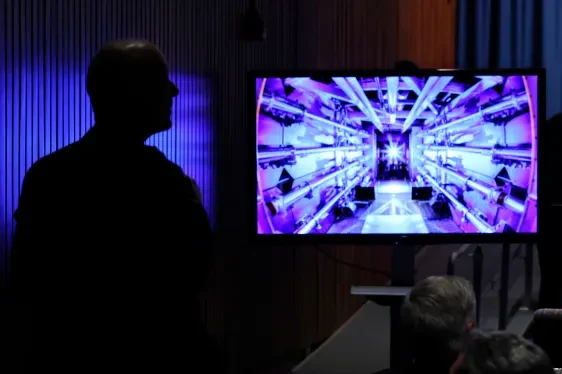
At NIF’s experimental facility, 192 separate laser beams are fired into a large vacuum chamber, all converging on a small gold cylinder called a hohlraum that holds a diamond-coated fuel pellet. When the laser energy hits the hohlraum, the cylinder vaporizes and emits X-rays that bombard the BB-sized fuel pellet inside. The diamond outer coating converts to plasma, which expands inward to compress the deuterium-tritium fuel at the core to the density and temperature needed for fusion.
This complex process sounds cutting-edge, but a critical hurdle remains for commercial use: to deliver steady power to the electric grid, this entire sequence needs to repeat several times every single second.
The core concept of laser-driven fusion was first theorized in the 1960s, originally developed as a safer method for researching thermonuclear weapons, though early scientists immediately recognized its potential for commercial power generation. Construction on NIF began in 1997, and it took 25 years of development and testing for the facility to reach the key milestone of scientific breakeven, where a fusion reaction releases more energy than was required to initiate it.
A growing cohort of startups including Inertia, Xcimer, Focused Energy, and First Light are now working to turn NIF’s experimental breakthrough into commercial-scale power plants. Because NIF’s original laser systems rely on outdated technology, these firms are betting that modern laser designs will be far more energy-efficient, cutting the input power required to trigger each fusion reaction and making it far easier to hit the net energy output needed for a profitable commercial plant.
Connect with your next investor or portfolio startup at Disrupt
Your next funding round. Your next key hire. Your next breakout opportunity. Find it all at TechCrunch Disrupt 2026, where more than 10,000 founders, investors, and tech leaders gather for three days of 250+ tactical sessions, high-impact introductions, and market-defining innovation. Register now to save up to $410 on your pass.
Connect with your next investor or portfolio startup at Disrupt
Your next funding round. Your next key hire. Your next breakout opportunity. Find it all at TechCrunch Disrupt 2026, where more than 10,000 founders, investors, and tech leaders gather for three days of 250+ tactical sessions, high-impact introductions, and market-defining innovation. Register now to save up to $410 on your pass.
The three new agreements between Inertia and LLNL include two strategic partnership projects, plus one formal cooperative research and development agreement. The teams will collaborate to develop more advanced laser systems and improve the design and manufacturability of fusion fuel targets, with the goal of boosting overall reactor performance. As part of the deal, Inertia is also licensing nearly 200 existing patents from the national lab.
The deepened collaboration between Inertia and LLNL is widely seen as inevitable. Annie Kritcher, Inertia’s co-founder and chief scientist, was a lead designer for the landmark NIF experiment that achieved the first-ever scientific breakeven for laser fusion. Provisions in the 2022 U.S. CHIPS and Science Act created a formal pathway for federal lab researchers to found private startups while retaining their positions at national labs, clearing the way for Kritcher to launch Inertia.
Fusion Startup Inertia Enterprises Inks Deal With LLNL To Commercialize Laser-Driven Fusion Technology